
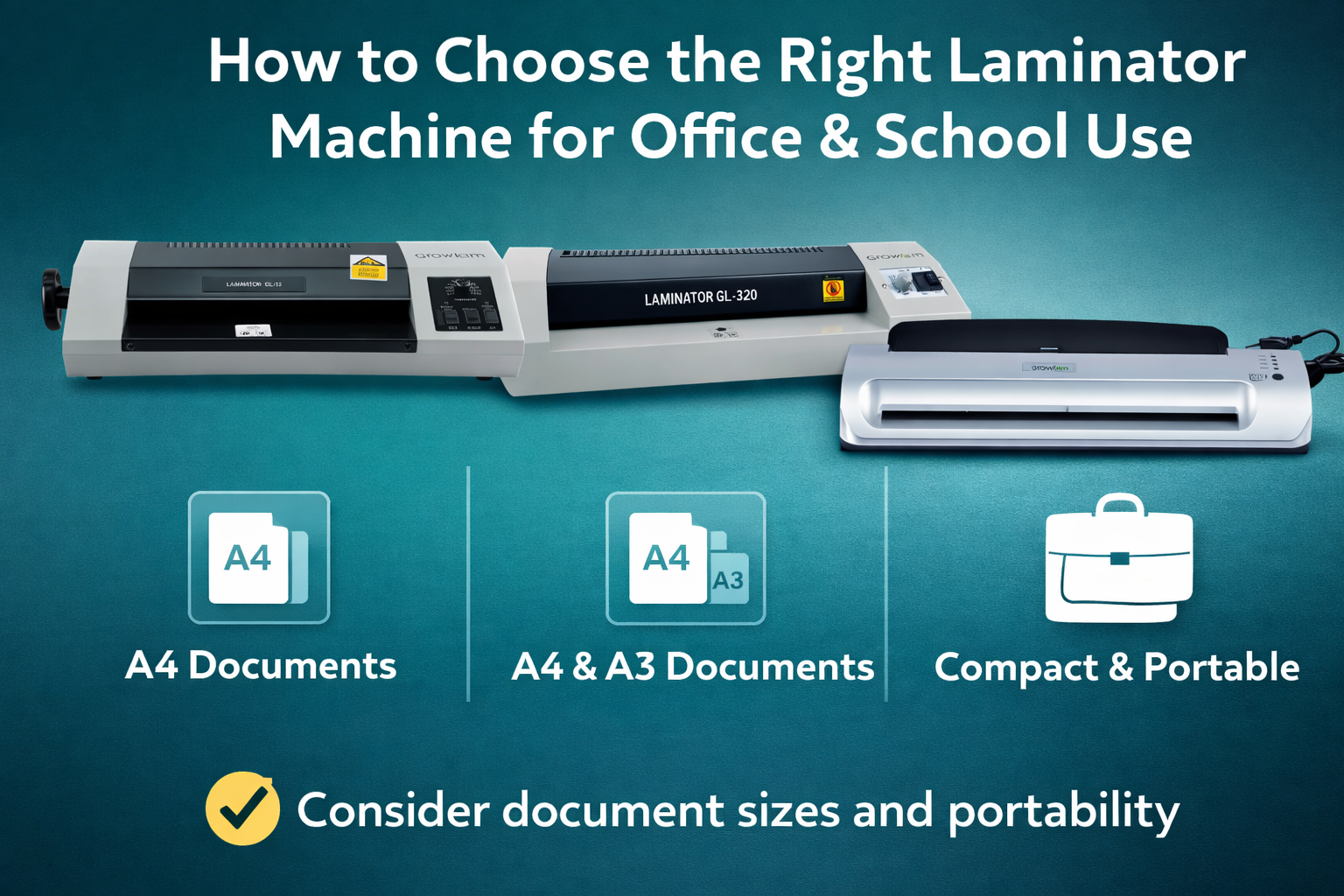
A good laminator is needed whether you are a teacher who wants to make tough flashcards to use in an active first-grade classroom, you want to make educational posters that can be reused, or you are an office manager that needs to protect important legal documents, contracts, presentations, and ID badges. It keeps paper dry, strong, and intact against tears, moisture, spills and provides materials with a professional and smooth look. Nevertheless, entering a supply store or visiting the internet, one could not help but be overwhelmed by choices: various entry widths, pouch thickness in a number of mills, heat options, warm up times and options such as jam prevention.
The choice of the incorrect laminator may cause exasperating complications: frequent jamming, puckering of the pouches, melting of the edges, bubbles within the lamination or even spoiled originals that have to be reprinted. When volume is high such as in schools (with seasonal projects such as back-to-school supplies, or science fair displays hiking usage) or in busy offices (where weekly reports, menus or training handouts are in use), reliability and efficiency are of the greatest concern.
This is a general guide that will contain all the information you need to know to select the ideal laminator that best suits your requirements including the type, important specification, safety, and maintenance, as well as brand suggestion. We will also point out Growlam which is a reputable brand in office supplies but is characterized by durable and versatile pouch laminators that are specific to office or school settings.
Understand the Main Types of Laminators
Begin by comparing the type of laminating equipment with your routine workload and the type of documentation.
Pouch Laminators
These are the most popular in most offices and classrooms. You place your document in a pre-mailer sized plastic bag (with an adhesive lining on the inside) and close the open end (where necessary) and roller press it.
- Advantages: Low-cost (can be as low as $30-200), small/portable, easy-to-use, works well with standard letter (8.5 x 11 inches/A4) or ID badge sizes.
- Disadvantages: Can use only pouch sizes; not suitable on long or continuous runs. Best: Occasional, such as laminating worksheets, certificates, signs, photos, or business cards. Pouch models are simple and most teachers and office workers like them.
Roll Laminators
These have big rolls of film on the top and bottom, and continuous lamination of oversized items without pouches is possible.
- Advantages: Works with banners, posters, maps, or other visuals of large classroom size (as wide as 27 inches or beyond). High-volume capable.
- Cons: It is more costly (more than 500 dollars), has a larger size, and can be harder to set-up and maintain (replacing rolls, turn-tension). Best applicability: Schools that have art rooms, media centers or offices that manufacture large-format signage on a regular basis.
Hot vs. Cold Laminators
- Hot (Thermal): Hot (approximately 230 300 F) is a process whereby heat is used to activate adhesive in pouches or rolls. Gives the best, most understandable, most lasting seal, one that is perfect in all day to day documents, menus, or school materials that require durability.
- Cold: It is based on pressure-sensitive adhesive (no heat). Important when dealing with heat sensitive products such as inkjet photos, photos, faxes, thermal paper receipts (turn black when heated) and some vinyl stickers. Most contemporary pouch laminators are available with a hot/cold switch.
A hot pouch laminator (with cold option) satisfies 90% of the requirements of most office and school use.
Essential Factors to Evaluate
Specify these features to align the machine with your day to day needs.
Entry Width (Maximum Document Size)
- 9 inch (A4/letter): It is big enough to accommodate standard documents and badges. Common in budget models.
- 1213 inches (A3 capable): much more flexible – can work with letters, or posters, certificates, or menus or trifold brochures without clipping in advance. Strongly suggested in schools (art projects, large flashcards) and at work (presentations, charts).
- Larger (18+ inches): This is only necessary when you constantly do banners thus over-kill to most users.
Pouch/Film Thickness (Mil Rating)
The thickness is expressed in mils (1 mil = 0.001 inch) or microns (1 mil ≈ 25.4 microns). Total thickness is on both sides of the pouch.
- 3 mil (75-80 microns): Thin and pliable- such as a flimsy menu or simple sign. Superior to temporary protection or those that require to be folded.
- 5 mil (125 microns): Classroom/office standard- solid but a little bit bouncy. Rests on heavy use without cracking.
- 710 mil (175250 microns): Rigid, professional – ideal to use on an ID card, luggage tags, bookmarks, or to put up in a heavy-duty area. Foldless; must be a machine with more thickness capability to prevent jams or seals that are not tight. Check the highest rating of the machine- most entry level machines go to 5 mil, and the mid-range machines go to 10 mil.
Warm-Up Time and Laminating Speed.
- Warm-up: 1-3 minutes are recommended in situations with a high workload. Those models, dubbed as instant or fast-start (less than 60 seconds), avoid waiting in a teacher’s lounge or mailroom, which is full of people.
- Speed: Standard speed is 12-15 inches per minute (IPM) or mm/min. Fast models (20-30+ IPM) would be used with high volume. An example is a speed of 300 mm/min machine working with an A4 sheet.
Other Practical Specs
- Power consumption (300 1000W): Reduced with home/office and increased with heavy-duty.
- Auto features: Auto-shutoff, auto-feed or temperature adjustment is a common feature on many.
Prioritize Safety and User-Friendly Features
In shared spaces, these prevent accidents and frustration.
- Auto-Shutoff: Powers down after 30–60 minutes of inactivity—essential for fire safety.
- Jam Release/Reverse Button: Critical. If a pouch misfeeds or wrinkles, reverse pulls it out before rollers get gummed up. Forward/reverse is a must-have.
- Cool-Touch Exterior: Insulated housing stays safe even during extended use.
- Anti-Jam Technology: Some models have sensors or special rollers to reduce jams.
- Carrier-Free Option: Higher-end machines allow carrier-free lamination for thinner pouches, saving time.
Office vs. School: Tailored Recommendations
| Feature | Office Choice | School Choice |
| Primary Need | Professional look, quick turnaround | Durability for heavy/student handling |
| Top Priority | Speed, photo-quality clarity | Large format, high volume tolerance |
| Frequency | Intermittent (reports, badges weekly) | High/seasonal (worksheets, posters daily) |
| Ideal Type | High-speed pouch (hot/cold switch) | Larger pouch or entry-level roll |
| Thickness Range | Up to 7–10 mil for cards/docs | 3–10 mil for flexible to rigid items |
| Entry Width | 9–12 inches | 12–13+ inches for posters |
| Winner Example | Compact fast models | Versatile A3 heavy-duty |
For most mixed-use scenarios (small office or classroom), a 12-inch pouch laminator handling up to 7–10 mil is the sweet spot—balancing cost, versatility, and performance.
Spotlight on Growlam Brand and Products
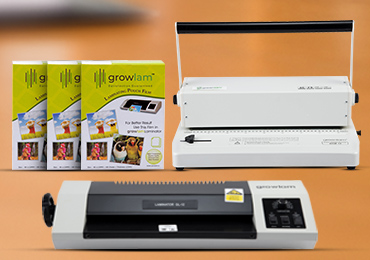
Growlam is a leading brand in office supplies, particularly popular in markets like India and for budget-conscious users worldwide. They specialize in pouch laminators, laminating films, and related accessories, emphasizing durability, German-inspired technology for precision, and all-in-one features.
Growlam machines stand out for metal bodies (better heat dissipation and longevity than plastic), hot/cold switches, forward/reverse functions, and compatibility with various pouch thicknesses. They’re reliable for both office professionalism and school demands.
Key Growlam models for office & school:
- Growlam GL-12: Heavy-duty A3 laminator with 330 mm (13-inch) entry width. Handles up to 250 microns (about 10 mil), speed around 600 mm/min, 620W power. Metal construction for commercial/personal use. Ideal for schools laminating large posters or offices handling oversized docs. Features forward/reverse and high-quality seals.
- Growlam GL-320 / GL-380 Series: All-in-one professional models with hot/cold options, forward/reverse, and speeds like 300 mm/min. Compact yet powerful (e.g., GL-380 for 75–125 microns pouches). Great for home/office/school with fast warm-up and anti-jam systems. The GL-380 is praised for efficiency in creative and document tasks.
- Growlam GL-390: Rapid 90-second warm-up, 230 mm entry (A4-focused), hot/cold, anti-jam. Perfect for intermittent office use or small classrooms—compact, fast, and versatile for photos, IDs, certificates.
- Growlam GL-490: 3-in-1 powerhouse (laminator + heavy-duty cutter + corner rounder). A3 capable, ideal for schools producing finished badges or cards in one setup.
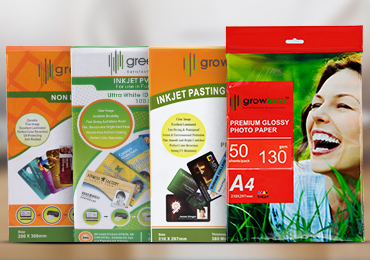
Growlam pouches pair best with their machines for bubble-free results. Users appreciate the brand’s value—durable builds at accessible prices, making them a strong contender against bigger names like Scotch, Fellowes, or GBC.
Popular alternatives include Scotch PRO series (fast, jam-resistant for teachers), Fellowes Saturn (reliable mid-range), and GBC Fusion (office-focused with quick warm-up).
Maintenance Tips for Longevity
A good laminator lasts 10+ years with care:
- Run cleaning sheets or cardstock through while hot monthly to remove adhesive buildup.
- Always laminate full pouches first—never pre-cut small pieces (adhesive bleeds onto rollers). Trim after.
- For hot machines, run on “cool” mode a few minutes before shutdown to avoid roller deformation.
- Store in a dust-free area; avoid overloading thickness/speed limits.
- Use quality pouches—cheap ones cause jams or poor adhesion.
Conclusion
The right laminator is reduced to your volume, document sizes and priorities. The optimal choice to most office/school users is a 12-13 inch hot/cold laminator that has a versatile design and has a fast warm-up time (less than 3 minutes), a reverse feature, and up to 7-10 mil support. Other brands such as Growlam are also doing very well in this category with a model such as the GL-12 to be used heavy or the GL-290 to be used compact.
Waste not, and you have invested in a time, material, and money-saving laminator that will pay off in saving you time and preserving the materials and catapulting everything between student work and professional papers in years to come. When you have either small sizes with the occasional large item, a Growlam A3 capable model will be a good place to begin with- you will not go overboard with it but still have a reliable model.
No Comments